Entradas

Mostrando las entradas con la etiqueta Catacaos

Today we'll paint about El Niño

Imagen
Heavy rains are the topic of those art pieces by boys, girls and teenagers in  Piura's vulnerable sectors.  Piura, Peru - Many people follow to quantify the effects of heavy rains by

Hoy pintaremos sobre El Niño

Imagen
Las lluvias torrenciales son el tema de estas obras de arte por niños, niñas y adolescentes de sectores vulnerables de Piura.  Piura - Mucha gente sigue cuantificando los efectos de las lluvias torrenciales por

A visit to Piura

Imagen

De visita por Piura

Imagen

Tourism and mentorship interested during the 2nd trimester 2019

Imagen
Tourism in Piura Region became an interesting issue for our English-speaker audience between April and June of this year. The analysis that Viajala.com did about this Peruvian territory, and quoted by CNN en Español, attracted muchly in Ecuador, then in Peru. It wonders us so much since the countries are mostly Spanish-speakers. Other dspecific destinations are Las Palmeras de Yaranche’s Coppers (Tambogrande) and Palo Blanco Community (Chulucanas), this last one specially in Peru. Again, the country is Spanish-speaker. Other stories that indirectly touch the tourism are the initiative of a Sullana-based radiostation to celebrate the Peru-Ecuador Peace Agreement , preferred in Ecuador, and the white cacao of Palo Blanco (Chulucanas) , preferred in Japan. The combination of art and health by using the theatre to improve the children’s feeding was tagged from Israel, Switzerland, and the United Kingdom. The natural disasters also took a place for the audience in two sto...

La salud interesó durante el 2º trimestre 2019

Imagen
Entre los meses de abril y junio, la gente que sigue los contenidos ofrecidos en español por la red FACTORTIERRA.NET comenzó a mostrar mayor interés en iniciativas de salud preventiva, particularmente la alimentación y el sexo seguro. En efecto, las dos historias que más llamaron la atención de la audiencia fueron cómo se está impulsando el consumo de alimentos ricos enhierro y qué prácticas sexuales podrían constituir un riesgo para la salud, especialmente pensando en el VIH/SIDA . Los países que prefirieron estos contenidos son Chile, México y Perú. Mientras tanto, los países que no son mayormente hispanohablantes se inclinaron por prácticas de salud preventiva enfocadas más en la actividad física o el bienestar personal. En efecto, la historia sobre cómo una playa en Paita fue usada para una clase de aeróbicos al aire libre ha sido favorita en Alemania y en Michigan (Estados Unidos); también en este último estado se detectó interés por el poder terapéutico de los masajes ....

Fighting Anemia And Dengue With Some Art

Imagen
CATACAOS, Peru - The Last Supper at 003 Kinder School is on scene. The moment which the Catholicism recognizes the trans-substantiation of the bread and the wine into the Body and the Blood of Jesus Christ is performed by 3-to-5-year-old children studying over there. There are seven dishes prepared around following an old Holy Week's local tradition - The Seven Meals. For Qali Warma, a Peruvian government food compplementary programme, the celebration has been an opportunity to introduce the consumption of iron-rich food, so fighting the anemia and the malnutrition. The buffet included rice, fish, corn, yucca, sweet potato, qinwa, and especially cow and goat blood, which iron concentration is very high and it was pointed out by the local Health officials as an accessible choice for improving the nutritional quality of boys and girls. The producers of the activity assure the kids left empty dishes. The school's principal Cristina Chunga Goicochea says the teachers encou...

"Éste es mi Cuerpo... enriquecido con hierro"

Imagen
CATACAOS, Piura - La Última Cena en el colegio inicial 003 está en escena. El momento en que el catolicismo reconoce la transsubstanciación del pan y el vino en el Cuerpo y la Sangre de Jesucristo es interpretada por niños de tres a cinco años que allí estudian. Alrededor, siete platos preparados en cumplimiento a una vieja tradición local de Semana Santa: Los Siete Potajes. Pero, para el programa de complementación alimentaria Qali Warma, dependiente del Ministerio de Desarrollo e Inclusión Social, la celebración ha sido una oportunidad para introducir el consumo de alimentos ricos en hierro y de ese modo combatir la anemia y la desnutrición. El buffet estuvo compuesto por arroz, pescado, maíz, yuca, camote, quinua y en especial la sangre de res y cabrito, cuya concentración de hierro es muy alta y ha sido señalada por las autoridades locales de Salud como una alternativa asequible para mejorar la calidad nutritiva de niños y niñas. Los organizadores de la actividad aseguran q...

Free Access To Narihualá Site Museum

Imagen
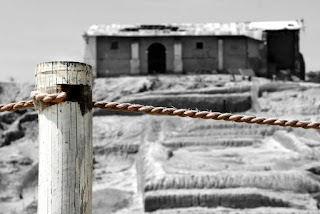
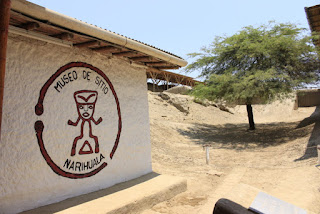
CATACAOS, Peru - If you are arriving into Piura City this Sunday, April 7th, or the first Sunday of every month, and you want to connect to the Pre-Hispanic past of Piura Valley, the Narihualá Site Museum is a good choice, just located 3 miles away or 10 minutes by car from Catacaos City. The Narihualá Site is an archaeological spot formed by a huaca (pronounce "waka") or sacred place built at the top of a hill, pressumibly Tallán origin, over which the Spaniards built a Catholic temple as part of idolatry extirpation policy adopted when they conquered Peru in 1532 AD. There is no consensus among archeologists about the nature of Narihualá yet. They suppose it was a military-political center, or a religious one, or a combination of both. What they have clear is that Narihualá could be the most important place for Tallán Culture , that fluorished in actual Piura and Tumbes Regions lowlands between 500 AD and 1470 AD. The Discentered Direction of Culture (DDC) annunced...

Acceso gratuito a Museo de Sitio Narihualá

Imagen
CATACAOS, Piura - Como todos los primeros domingos de mes, este 7 de abril el acceso al Museo de Sitio Narihualá, ubicado a solo cinco kilómetros o diez minutos en cualquier vehículo desde la ciudad de Catacaos, será gratuito, informó la Dirección Desconcentrada de Cultura (DDC) este viernes. Narihualá es un sitio arqueológico consistente en una huaca o lugar sagrado presumiblemente tallán, edificado en la cima de una colina sobre la que los españoles edificaron a su vez un templo católico, como parte de su política de extirpación de idolatrías durante la Conquista del Perú, iniciada en 1532 DC. Los historiadores no llegan a un consenso sobre si fue una fortaleza de carácter político-militar, religioso, o una mezcla de todas; sin embargho, sí coinciden en que el lugar pudo ser la población más importante de la Cultura Tallán , que se desarrolló principalmente en la costa de los departamentos de Piura y Tumbes entre 500 DC y 1470 DC. La DDC, que depende del Ministerio de Cult...

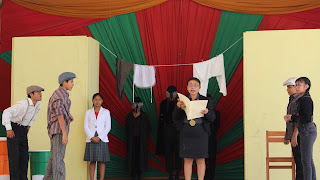
Estrenan obra teatral "Zikario no es de este barrio"

Imagen