Entradas

Mostrando las entradas con la etiqueta archeology

Millenarian art of Malingas goes out in parade
Imagen
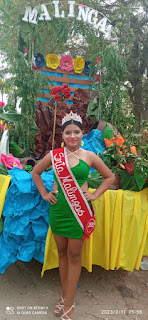
  Photographs by Milton García , distributed by FACTORTIERRA.   TAMBOGRANDÉ, Peru – The petroglyphs of Malingas were used as inspiration to make up an allegorical chariot as part of the carnival parade performed in this city on February 11 th , 2023. The chariot presented by Malingas Village Municipality got in brief the touristic potentials of the community – the landscape and the archaeological rests .   In the first case, San Francisco Creek was stylized as that is a Piura River tributary, that serves like the northern border for the community.   In the second one, one of the traces existent in Malingas was framed, that according to the preliminary investigation by the archeologist Daniel Dávila, made between 2009 and 2011, they might be 4000 years old, made by migrants getting from Amazon Basin, having such as relation with the existence of water. Check out the full sightings.   The investigation about Malingas Petroglyphs was promoted b...
Between Morán Mount and Platillos

Imagen
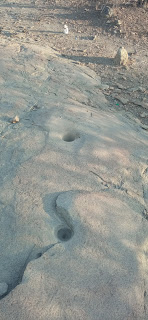
A trekking trail connecting at least three sites with archaeological evidence in Malingas.   Photographs gathered by Milton Garcia Navarro   TAMBOGRANDÉ, Peru – In 2011, FACTORTIERRA announced to the world the existence of an archaeological rests network that could be until 4000 years old, located at the central part of Malingas Community . Basically, it’s about evidences of art-on-the-rock on and around Malingas Cord, a branch formed by five mounts apparently caused by volcanic activity judging the basalt that mostly forms their slopes. More than a decade later, it’s starting to value the touristic potential the zone has, despite the sites have not officially confirmed yet, they just have a preliminary survey by the archaeologist Daniel Dávila Manrique , the first scientific explorer of the zone between 2010 and 2011. “I’d like to return, make a new survey of every site,” Dávila said to FACTORTIERRA, when he learned about the initiative of giving them a touristic...

What must it be saved in Kuélap?

Imagen
At least during three years, touristic guides and businesspersons warned there would be a collapse.     LÚYA, Peru – In 1998, Peruvian Government declared the archaeological complex of Kuélap as cultural patrimony. The touristic reviews describe it like an architectural jewel built by the ancient Chachapoya people , a little confederation of communities settled down in the steepest, wildest lands between Marañón River to the west and Huallaga River to the east. In Peru dimensions, it’s about the Upper Jungle or Rupa-Rupa eco-region – the mountain rain forest, actually, already in Amazon Basin .   The chahchapoya or shacshapooyo (fog’s people, in English) flourished between 900 and 1470 AD extending between the south of Amazonas Department , all the western half of san Martín Department, and the eastern side of La Libertad Department. They were contemporary of the Incas what conquered them during the reign of Tupac Inca Yupanqi who started the expansion of ...

Tunal Petroglyphs

Imagen
A Catholic cemetery keeps a… pantheistic shrine? By Nelson Peñaherrera . Photos by Alesban López .   SAPILLICA , Peru – “Cachirís Mount is straight there and Pilán Mount is mostly on the right,” Sapillica [pronounce “Sapijicah”] District Municipality’s Alesban López points me out, whom I am riding a motorcycle again , on our way to Tunal, 37 km away the southwest of the district capital. A local told him there are rocks “pretty identical” to those he featured on his Facebook account . We have to go down from Sapillica town until Timbes [pronounce “Timbehs”], then climbing up until 1617 meters altitude according to the GPS ( global positioning system ) device the crew carries within.   An hour 20 minutes, at least on motorcycle, by the west flank of Andean Western Range, viewing the coast along the full trail. In Tunal, we are on the spine of the mountain, the rocks are so little (1,5 meters by si, approximately) those just could carve one petroglyph per each one...

The Real Price Of La Capilla

Imagen
The agricultural-exporting present  and a highly possible archaeological past are its two main assets, at the moment. All photographs by Ángelo Azabache , distributed by FACTORTIERRA   SULLANA, Peru - In the place where the towns of West sullana and Jíbito are up to join, but more aligned near Chira River , it is located La Capilla, the site where a same-named big estate was controlled from, in which farms the Bishop Baltazar Jaime Martínez d Compañón y Bujanda gota gifted property to founding Santísima Trinidad de La Punta Village, on July 8th, 1783, the coretown of Sullana Metropolitan Area the second largest of Piura Region. Then, La Capilla belonged to Del Castillo Family and seemed to enlarge across  the space that cities of Sullana and Bellavista occupy today, although the official history says the estate which terrain the town was founded, was called La Punta (The Point, in English) what might explain its initial name, however its founder tried to name...