Entradas
Se muestran las entradas que coinciden con la búsqueda de Coastal Piura
The Conqueror's Mistake
- Obtener vínculo
- X
- Correo electrónico
- Otras apps
The relationship between Piura City and the water has not been one of the most positive, misunderstandings are older than its Spanish foundation. By Nelson Peñaherrera PIURA CITY , Peru - It is supposed that Francisco Pizarro founded San Miguel on August 15th, 1532, becoming the first Spanish Empire's city in South America, locating it over the Tallan [pronounce "Tajahn"] town of Tangarara, actual Marcavelica District, just beside Chira (then Turicarami in Tallan language) River. What promised to be a productive convivence -the soil was pretty fertile- turned disease soon. Malaria decimated the immigrant population, that decided to move away the river . In 1534, it went about 50 miles SE of Tangarará, next to Pilán Mount, Monte de los Padres Acres and Las Damas Creek, actual La Matanza District. Although Lengash River ran nearby, the city did not located beside this time. It could be renamed as Piura (supposedly from quechuan "Pir...
A Rain Radar For Piura
- Obtener vínculo
- X
- Correo electrónico
- Otras apps
After the visible vulnerability during Coastal El Niño, a modern equipment gets ready for alerting us what happens in the sky real-time . By MSC. Rodolfo Rodríguez ( University of Piura ). Graphics and photographs provided by University of Piura. PIURA CITY, Peru - The flood-affected towns caused by Coastal El Niño claim a never-again about such disasters. The summoned ones to change the history are, first, the (regional and national) governments , then the technical and scientific instances for weather, climate, and disaster management & following-up. They all must consider that also the lack of warning for the projected works resulting seriously affected, as well as the bad settlement and construction of public infrastructure, and precariousness of many houses at rural zones, are factors increasing the vulnerability of a country. Regionwide, after El Niño events occured often, we must step ahead for counting with an efficient system of early alert tha...
Who didn't move my cheese?
- Obtener vínculo
- X
- Correo electrónico
- Otras apps
Although goat cattle predominates in Piura Coast, it does not consolidate a market for competing beyond its boundaries yet. All photos by William Curay , provided to FACTORTIERRA. MARCAVELICA, Peru - Taking advantage of September 24th Piura 's holiday, in Cañas Village an habit has been started during the last years: having a fair dedicated to goat cattle. It is about one of the three towns benefit with projects to generate productive chains around the milk of those animals brought by the Spaniards in 16th century, those found a pretty good environment at lowlands here. Cañas is about 25 km or 15.5 miles to the north of Mallarés Town, what is 13 km or 8,8 miles to the northwest of Sullana City. The road is easily accessible as light as it rains. In Peru, approximately 210,000 families work and depend on growing goats. The majority of those little growers have unsatisfied basic needs. In Piura case, the majority live at Equatorial Dry Forest , a coastal ecosystem...
The New Piura
- Obtener vínculo
- X
- Correo electrónico
- Otras apps
The functional vision and mission of a less vulnerable city before El Niño. By Julio ernesto Gianella * PIURA CITY, Peru - The knowledge we have not assimilated from Pre-Hispanic people is the urban planning. The best proof is that many of the cities built in the past are still there despite the natural disasters and the time lapse. The city of Caral ( Supe , Lima ), the most ancient of South America, was wisely built and it has not suffered from floods , Nature's onslaugths neither, in 5000 years of existence. The virtue of urban planning is upon the balance between the what we want and what we can. If it has no contribution of the vision and the wishes on a better future, we stay trapped into more of the same; in the other hand, if it exceeds in futurist dreams, it crashes into the reality and detracts. That is why the main basis of the Piura's future planning must be the non-vulnerability before the nat...
When Tambogrande Downtown became an island
- Obtener vínculo
- X
- Correo electrónico
- Otras apps
Local el Niño's heavy rains smashed the place where a mine was almost to drill. By Liliana Alzamora and Nelson Peñaherrera TAMBOGRANDÉ, Peru - Santa Cruz hill, now in the middle of the town, was in prehistoric times a dome volcano. Its red soil, rich of cooper, is the evidence of a hot past. Nowadays, any volcanic activity happens in or around but the people. Only a decade and a half ago, many opposed to a proposed open-pit mine that implied to remove the so-called Old Town, Tambogrande downtown actually. Seen from the top of Santa Cruz Hill in a usual summer, Tambogrande looks like invaded by a green tide by the east, the North and the West - San Lorenzo Valley Colonization, the main mango and lime production area in Piura Department , at Peruvian Northwestern. The Old City remains there after the population defeated the formerly called Manhattan Minerals Corp., today renamed as Mediterranean Resources . However the green tide was not completely gre...
The first doubt about 2017 El Niño
- Obtener vínculo
- X
- Correo electrónico
- Otras apps
The crown's on its way
- Obtener vínculo
- X
- Correo electrónico
- Otras apps
The so-called king of the desert doesn't expand all its majesty yet. It is considered as the emblematic tree of Piura Department's Coast -it normally doesn't grow over than 1650 feet altitude- and it is supposed the Spaniards found it here dominating the landscape when they arrived here in 1532. The conquerors fastly related it to the European carob tree ( Ceratonia siliqua ), then assigned that name to the species that locals called tahko , according to a Food and Agriculture Organization (FAO)'s research , although some archeologists asked by FACTORTIERRA doubt about that theory. the carob word, actually, has Arabic roots - alarrooba , coming from Persian alarroob what means donkey's jaw, curiously the animal that consumes it a lot and never stops to chew it here in Piura. However, the word describes the European species, apparently not related genetically to South American one, the Prosopis pallida actually. FAO states Italian scientist ...
Upward Curve
- Obtener vínculo
- X
- Correo electrónico
- Otras apps
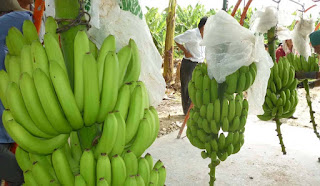
Piura's banana opens its way fastly in the international market. LOS ANGELES, Calif. -- American people look like to love banana, so Dominican Republic seems to be the spoiled one. The Caribbean country is the main provider of the fruit, Peru is just behind. The United States International Trade Commission reports that Peru's banana exportation was US$ 53 million in 2015. U.S. is the main market for Peru. According to Peru's Foreign Trade Office in Los Angeles, it could displace Dominicans in the short term if it makes the productive chain more competitive, what means a more attractive value added, and researches to avoid the plagues can decimate the production. In fact, one of the challenges for Peruvian producers is keeping black sigatoka ( Mycosphaerella fijiensis ) away, a very common disease in Dominican Republic and Mexico as well, the other fruit producer. Both combined represent the half of the world's share. At least in the U...
A traditional spa under siege
- Obtener vínculo
- X
- Correo electrónico
- Otras apps
By air, sea, and land, big and small have punished Colán to die. By Nelson Peñaherrera Castillo COLÁN, Peru – Before Máncora left it down to a second place –that is also losing—, this one was the spa of Piura for instance. Now, it is condemned to go degrading, droned by corporate and communitarian interests that can sweep centuria of tradition, like the moment they wounded the cliff that keeps it. La Esmeralda de Colán, better simply known as Colán , is exposed to its water pollution and the waves that threaten the building close to(not mentioning over)the rim. A natural phenomenon is the killer that condemns it to a slow death. The confluence of Humboldt and El Niño Currents also carry on died animals that get stranded on the rims: porpoises, sea lions, and dolphins have been reported at the zone. Miguel Alarcón Ato, president of La Esmeralda’s Association of Residents and Owners, suspects that the combination of industrial sewerage from Paita City to th...