Entradas

Se muestran las entradas que coinciden con la búsqueda de Poechos Reservoir

Saving Poechos

Imagen

Increasing the capability by rising the height – that’s the idea

Imagen
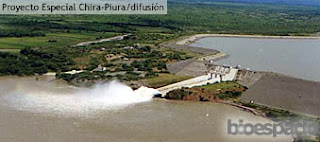
The plan is providing, gradually along 2024, additional 65 million cubic meters to Poechos Reservoir, the largest of Peru.   LANCONÉS, Peru – Chira-Piura Special Project (PECHP by its initials in Spanish) plans to rise the operation height of Poechos Reservoir, the largest of Peru, until 105.5 meters (346.2 feet) altitude along 2024. In that sense, it will evaluate, based upon a filling plan, to take the decision for holding that height as the top operation level in the next years.   This Will allow Poechos to increase about 65 million cubic meters  (17 million gallons) of water not making an additional investment in infrastructure, built initially in 1972 and started in 1976, to store until 1 billion cubic meters. Because of sedimentation, this capability has been reduced in 55%.   The procedure was announced by PECHP’s President Victor Garrido Lecca Ramos, after holding coordination meetings with the National authority of Water’s (Ana, by its initials i...
It’s agreed a new study to unclog Poechos

Imagen
LANCONÉS, Peru – Poechos reservoir is only capable to contain 42% of its original capability. Chira-Piura Special Project (PECHP as in Spanish)’s director eugenio Tadeo Ramos revealed that the sediments raise 520 million cubic meters. A little lower than the half of the whole matter erupted by the broken out volcano at La Palma Island (Spain) in September 2021.   The reservoir, built since 1972 and starting operations four years later, was conceived to contain until 880 million cubic meters, with an option to enlarge until 1 billion cubic meters, of water. Its purpose was irrigating Chira and Piura Valleys, that form the most lowlands of Piura Department – its impact area includes five of its eight provinces.   Poechos is the largest artificial lake in Peru, that has full by sediment in almost half-a-century of operations due to deforestation at Catamayo Basin (Ecuador) and the massive water overloads caused by heavy rains during El Niño events in 1983 and 1998. ...

But the wáter lacks

Imagen

Submerged and buried

Imagen
While the Peruvian hydraulics celebrated a triumph, she lost a great part of her life.   By Nelson Peñaherrera Castillo . Photographs by Franco Alburqueque .   LANCONÉS, Peru – Benefit for farmers or a dictatorship’s megalomania?Over 800 million cubic meters  --4/5 parts of its capability— Poechos Reservoir begins the water transference from Chira River to Piura River .   Not all people share the joy. Turning 74 years, Mariana Távara settles down far her home, now submerged under all that liquitd amount. On behalf of the departmen’s agricultural expansion, she must brand a new life next to her family in a town with almost all the comfort, but her heart. “The history of Lanconés finished with Poechos Dam,” she states 35 years later.   Walking among rim orchards When Sullana Province just crowled 8 months old, Mariana born in Lanconés, a village located at Chira River’s rim near Ecuador. It was mid-July. “It was a little town with wood houses...

It’s raining!

Imagen
They said that 2012 would be a dry year… they said.   By Nelson Peñaherrera Castillo   PIURA CITY, Peru – Sánchez Cerro Vridge, February 24 th , 2012, 7:00 in the morning, 1400 cubic millimeters per second. The water is colorized by the violent improvisation instead of the unexpected. Piura River overload was the season attraction after months and months looking a flow like a creek-category.   The cement coat of Eguiguren Pier avoids the flow power to erode the banks of Piura and Castilla Cities, like it happened in 1983. The work was build after 45 miles to the west, El Niño Current caused extreme rains between January and June of that year.   The river put the people on alert in 1998, 2001, and 2005. Just in 1998, the power of water destroyed Bolognesi Bridge, the fourth from north to south, killing around 50 people. “I’m not never going to forget that number – 4414 cubic meters per second,” El Tiempo’s journalist Teo Zavala remembers. After that tragedy, every ...